| Brand Name: | YNTECH |
| MOQ: | 1 |
| Price: | 50000-100000 |
| Payment Terms: | T/T |
| Supply Ability: | 40 sets per month |
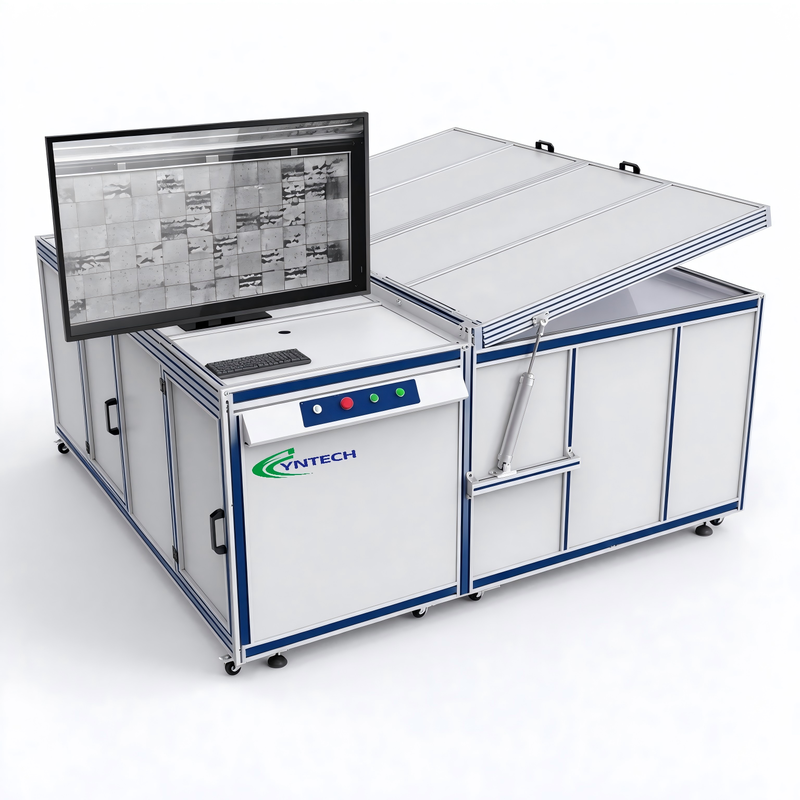
Selection Guide for EL Defect Testers | Electroluminescence Inspection
When evaluating suppliers of semi-automatic EL defect testers, buyers should focus on three core dimensions. First, the background and scale of the R&D team, which determines the equipment’s future upgrade potential. Second, the in-house quality control system during manufacturing, such as whether full-process quality traceability is available. Third, support for customization on demand, including mechanical hardware structure, software algorithms and integration solutions to match existing production lines.
Four typical questions frequently arise during equipment selection:
Resolution depends on camera and lens selection. For conventional solar cells of 166 mm or smaller, industrial cameras with no less than 12 million pixels are recommended, together with lenses with good distortion control. Semi-automatic EL testers can adapt to different module sizes by adjusting object distance and focal length. Buyers may request suppliers to provide comparative EL images of standard samples for evaluation.
Reliability can be verified from three aspects: reserved hardware interfaces (e.g. custom light source trigger signals), expandable defect libraries built into software algorithms, and proven project references of similar customised solutions. For custom projects, Wuhan Yaohua Laser carries out process parameter simulation and tuning before mechanical modification, to guarantee that customized functions work stably under real production conditions.
Large-format modules impose stricter requirements on platform flatness and image stitching algorithms. Semi-automatic systems must support segmented image capture and automatic panorama stitching via software algorithms. In addition, the current stability of the electroluminescence excitation power supply and the clamping force of contact electrodes need to match the resistance characteristics of large-size modules; otherwise, false defects caused by uneven brightness will occur.
Semi-automatic equipment generally cuts initial capital investment by around 30%, with a smaller footprint and flexible product changeover. Its limitation lies in slower cycle time due to manual loading & unloading, making it suitable for low-volume production or R&D validation. If daily module output exceeds 3,000 pcs, a fully automatic solution is suggested. For daily output between 1,000 and 2,000 pcs, semi-automatic EL testers deliver better overall economic benefits. Buyers can make decisions according to their actual takt time and product mix.
To sum up, semi-automatic EL defect testers strike a good balance between inspection accuracy and investment cost. A supplier’s technical know-how and custom service capacity directly affect equipment service life and consistent inspection performance.
![]()