| Brand Name: | YNTECH |
| MOQ: | 1 |
| Price: | 50000-100000 |
| Payment Terms: | T/T |
| Supply Ability: | 40 sets per month |
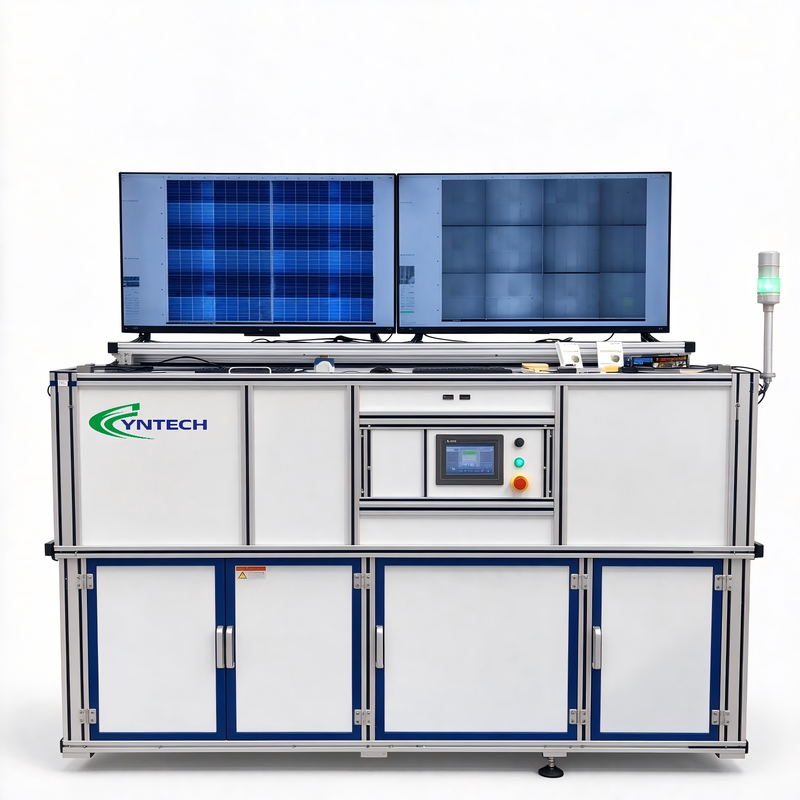
1.Why shoot: perform CT scanning on the component
You can think of it as getting a CT scan for the human body. Visual inspection is like checking the skin, while EL inspection is like examining the bones and internal organs.
![]()
Visible defects include glass cracks, air bubbles, frame scratches, dirt and color difference; invisible ones include hidden cracks in silicon wafers, cold solder joints under solder ribbons and broken fine grid lines. EL inspection can capture exactly these three types of defects.
It does not conflict with IV testing; they have separate responsibilities. IV testing tells you how many watts this module has lost, while EL inspection identifies which cell and which line causes the power loss. One provides the result, the other pinpoints the location.
It also has an advantage that visual inspection can never match: precise localization. Instead of simply stating "this module is faulty", it can specify "the 5th cell in the 3rd row, two centimeters to the left of the main grid".
2.The three most common EL defects
Hidden Crack. Microcracks in the silicon body of silicon cells caused by mechanical stress. The cells are not completely fractured and separated, so they are invisible from the exterior. However, the crystal lattice has cracked, which counts as damage to the silicon substrate. This area will not emit light when energized, appearing as a black line on EL images. The magnitude of power loss depends on the location: if the main busbar is not severed, the power loss of a single cell is 1%–3%; if the main busbar is cut through, the loss reaches 25%–50%.
Cold Solder. No proper alloy contact forms between the solder ribbon and the cell main busbar — they are attached mechanically but electrically disconnected. On EL images, this appears as irregular, intermittent local dark spots or dark lines along the busbar direction. The consequence is high contact resistance, which may lead to power loss in mild cases or local overheating in severe cases, creating the risk of hotspots.
Broken Finger. Partial fracture of the fine cell fingers (silver fingers) breaks the current collection path, showing up as black or dark areas perpendicular to the main busbars. This defect is mostly attributed to poor incoming material quality, and the power loss of a single cell usually exceeds 5%.
Besides these three types, EL inspection can also detect black cells (no light emission across the whole cell), broken cells, and mismatched cells (obvious brightness inconsistency between adjacent cells). Nevertheless, hidden cracks, cold solder joints and broken fingers occur most frequently and are the most likely to be overlooked.
These three defects share one common feature: they are all concealed inside the encapsulation and cannot be identified visually, yet all impair power generation performance and long-term reliability.
![]()