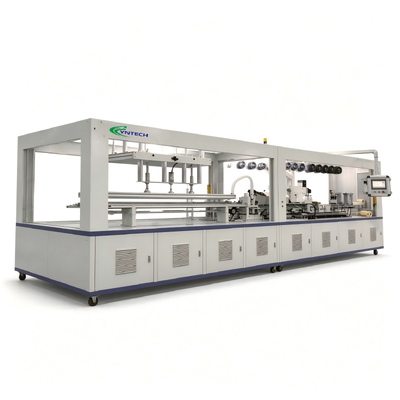
New Construction, Capacity Expansion, Upgrading And Technical Retrofit Of PV Module Encapsulation Lines.
Packaging Details:
Wooden case
Product Description
PV cell stringing is a highly technical and core procedure in photovoltaic module production. Tinned-copper PV ribbons interconnect individual solar cells in series to raise the output voltage of finished modules. The quality of stringing directly determines power output and long-term reliability of solar panels, making it a key quality control checkpoint in PV factories. Uncontrolled stringing defects may trigger batch quality issues in subsequent lamination and testing stages and drive up high rework costs. Below we break down the most typical defects encountered during cell stringing. 1. Cold Solder: High-Risk and Prevalent Stringing Defect
Cold solder is one of the most common failures in stringing. On EL electroluminescence images, cold solder areas appear black.
A cold solder joint means the ribbon and cell busbar fail to form sufficient and stable metallurgical bonding. This defect will reduce module power output. Worse still, the poorly bonded ribbon may peel off during lamination. If the loose ribbon touches an adjacent cell string, it will cause an internal short circuit inside the module, which further brings risks of hotspots and permanent damage.
Cold solder is mainly caused by insufficient soldering temperature or inadequate heating time, where the tin alloy cannot fully wet the silver paste on cell busbars. 2. Ribbon Misalignment off Busbars
PV ribbons are designed to be soldered precisely onto cell busbars. Busbars collect and conduct electric current from solar cells. Once the ribbon drifts away from the busbar, multiple problems will occur:
• Secondary cold solder due to reduced contact area;
• Higher internal series resistance. The current travel path is extended, resulting in extra power loss;
• Lower power generation efficiency. Misplaced ribbons cover extra active cell area. Busbars themselves do not generate electricity, and extra shading from offset ribbons further cuts down effective light-receiving area.
This defect usually stems from positioning or ribbon feeding inaccuracy of the stringer. The stability and coordination of machine systems become more critical for half-cut cells and fine-busbar cells. 3. Other Typical Defects: Over-Soldering, Microcracks & Ribbon Bulges
Apart from cold solder and ribbon offset, production also sees over-soldering, invisible cell microcracks, abnormal ribbon bulges and other issues:
• Over-soldering: Excessive temperature or prolonged heating erodes busbar silver paste. The solder joint turns brittle with rising resistance, harming module performance and durability.
• Microcracks: Improper pressure from welding heads or uneven thermal shock creates invisible cracks inside cells. These cracks keep expanding under outdoor thermal cycling and eventually lead to module failure over service life.
• Ribbon bulges: Malfunction of ribbon feeding or pressing units causes ribbons to arch up, which may lead to cell cracking or short circuit after lamination. 4. High Requirements for Stringer Equipment & Operators
A solar cell stringer is mechanically complex, requiring high synchronization among cell feeding, ribbon delivery, positioning, thermal soldering and pick-up subsystems. Minor parameter deviation can trigger continuous defective products.
A high-precision, stable PV stringer paired with skilled operators and equipment technicians effectively lowers defect rates of cold solder and ribbon offset, reduces rework and material waste, and lifts overall line throughput. This explains why stringing operators and equipment maintenance positions usually have better compensation compared with other workshop roles in PV module factories.
Conclusion
Most stringing defects cannot be identified by visual inspection and require EL testing for detection. The associated power attenuation and short-circuit hazards will exist throughout the 25-year service life of solar modules.
To stabilize stringing quality, standardized process parameter management is essential. Equally important is selecting a reliable, high-accuracy solar cell stringer, which prevents batch quality failures such as cold solder and ribbon misalignment from the equipment side.