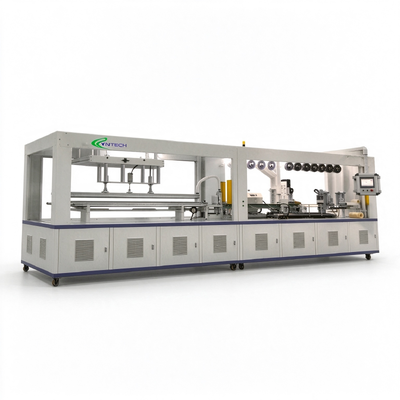
New Construction, Capacity Expansion, Upgrading And Technical Retrofit Of PV Module Encapsulation Lines.
Packaging Details:
Wooden case
Product Description
Tabber string soldering is a highly important and technically demanding process in the production of photovoltaic modules. This article is quite long, and I hope everyone will take the time to read it carefully.
Purpose of string soldering: The voltage of a solar cell is approximately 0.6 V, which is obviously insufficient for regular use. This gives rise to the string soldering and shingled soldering processes (shingled soldering will be covered separately later). Their purpose is to connect individual solar cells in series to raise the output voltage of the module. Take the 144 half-cell module as an example: it contains 12 cell strings inside. Six of these cell strings are connected in series, and this group is connected in parallel with the other six series-connected cell strings.
Materials for string soldering: To connect solar cells in series, a conductive medium between two cells is required, namely the photovoltaic solder ribbon.
A photovoltaic solder ribbon consists of a base material and a surface coating, typically tin-plated copper. The copper base must have precise dimensions, excellent electrical conductivity and adequate mechanical strength. Special processes including surface coating, vacuum deposition, spraying or hot-dipping are used to evenly cover the copper substrate with coating materials such as tin alloy at a specified composition ratio and thickness. Tin plating is applied because copper has a high melting point and poor solderability. With a tin coating, the solder ribbon can be firmly bonded onto the busbars on the surface of solar cells.
Excluding the ribbons at the start and end of the string, which are only slightly longer than the solar cell, the middle ribbons are approximately the length of two half solar cells. They connect the back side of one solar cell to the front side of another, forming a series connection between the two cells. Repeating this process allows multiple solar cells to be connected in series.